

Have a project where the schedule needs acceleration? Do you have varying labor
hours each week/day based on crew needs? Not sure how to quantify the additional
costs?
Purpose
This paper explains when loss of productivity (LOP) factors become relevant in construction projects and how to properly apply them, focusing on overtime and shift work impacts as described in the MCAA Management Methods Bulletin OT1 & OT2 (2020).
What Is a Loss of Productivity (LOP) Factor?
A Loss of Productivity (LOP) factor represents the decline in labor efficiency that occurs when work is performed under less-than-ideal conditions.
In construction, productivity means how many labor hours are required to complete a unit of work (e.g., feet of pipe installed per hour). When conditions worsen-such as through excessive overtime, overcrowding, poor coordination, or fatigue workers accomplish less per hour, leading to cost overruns and schedule risk.
LOP factors quantify that difference so a contractor can:
- Forecast labor inefficiencies in change orders or schedule accelerations, and
- Support claims or negotiations when unplanned conditions reduce productivity.
When Are LOP Factors Relevant?
LOP factors come into play anytime actual field conditions differ materially from the baseline that was assumed in the estimate.
Common scenarios include:
A. Unplanned Overtime
- Added to recover lost schedule or meet acceleration directives.
- Causes fatigue, lower morale, increased accidents, and absenteeism.
- Productivity decreases progressively over consecutive weeks of overtime.
- Even the straight-time hours worked during an overtime week are less efficient.
B. Shift Work
- Working second or third shifts introduces lighting, supervision, and coordination challenges.
- Night work often experiences 10-25% lower efficiency due to fatigue and transition losses between shifts.
- Requires additional supervision, lighting, heating, and tool/equipment coordination.
C. Disruption and Acceleration
- When project delays beyond the contractor’s control require acceleration.
- Owner or GC may direct overtime or added shifts; these directives trigger entitlement to both premium pay and inefficiency compensation.
Why Productivity Loss Can Exceed Premium Pay
Pay It’s common for project owners to agree to pay overtime wages but deny inefficiency costs.
However, the indirect costs of lost productivity often exceed the premium pay.
For example:
Paying 150% wages for overtime might seem fair, but if labor output drops by 30%, the true cost is far higher.
Recognizing and quantifying this difference is essential to protect project profitability.
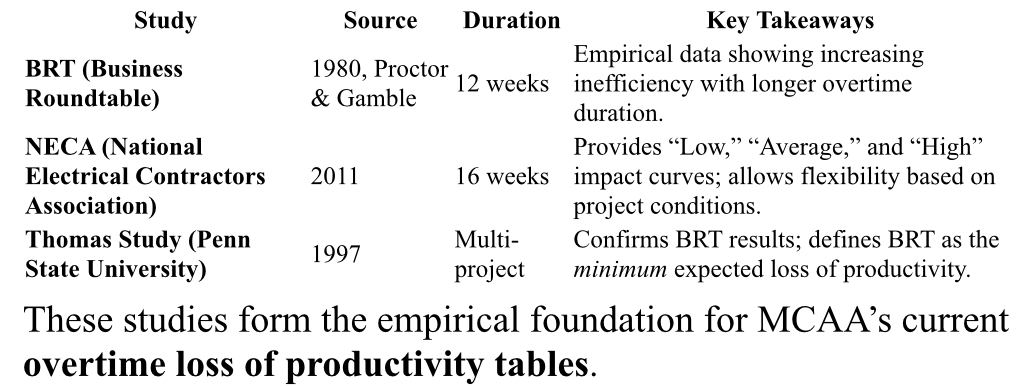
Industry Studies Supporting LOP Calculations
MCAA recognizes three primary studies as the industry standard for overtime-related LOP:
How to Apply LOP Factors
Step 1: Determine the Overtime Type
• Spot overtime (1–2 days): Minor or negligible impact.
• Extended overtime (multiple consecutive weeks): Use LOP tables.
• Planned overtime (in bid): Include inefficiency in your estimate upfront.
Step 2: Select the Appropriate Data Source
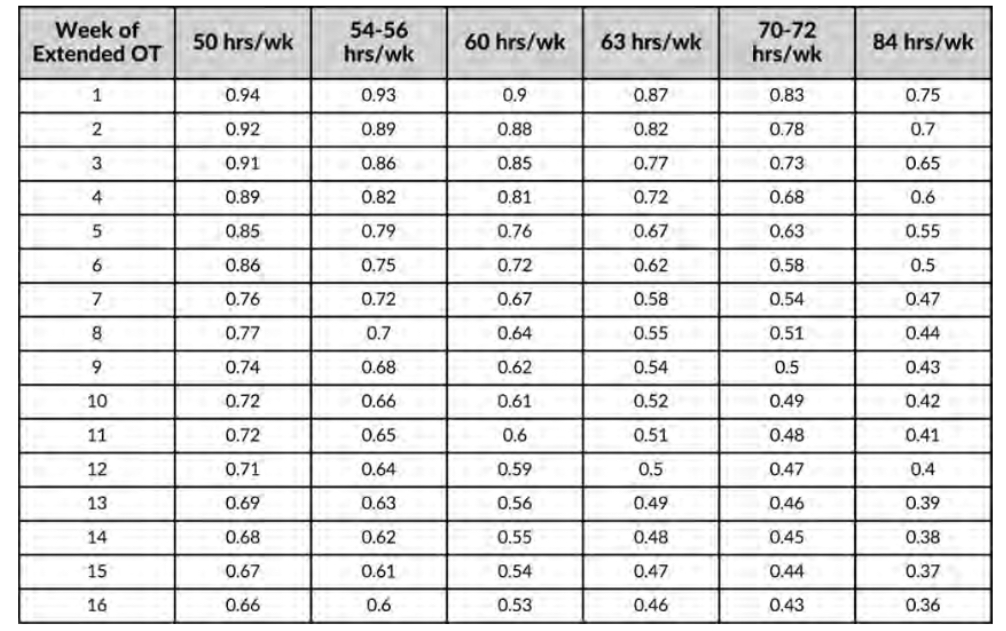
Use MCAA’s tables or NECA curves based on the overtime schedule and duration (e.g., 5x10s, 6x10s, 7x12s).
Step 3: Convert Productivity Index (PI) to Inefficiency %
If PI = 0.85 → 15% productivity loss (1.00 – 0.85 = 0.15).
Step 4: Choose Analysis Type
• Forward (Prospective) Analysis:
o Used when pricing a change order before the overtime occurs.
o Multiply inefficiency % by estimated labor hours for that period.
o Example: 1,000 hours × 20% = 200 lost hours.
• Retrospective (After-the-Fact) Analysis:
o Used after work is completed to compute actual loss.
o Adjust for inefficiency already embedded in payroll hours:
Lost Hours = Actual Hours – (Actual Hours ÷ (1 + inefficiency %))
Key Application Rules
• Apply inefficiency percentages to all hours worked during an overtime schedule, not just overtime hours.
• Reset the inefficiency curve if the crew returns to a normal 40-hour week (rest period “resets” productivity).
• Use measured mile analysis when possible for the most defensible results.
• Keep daily field records of labor hours, overtime schedules, and project conditions.
How to Protect Entitlement
When directed to work overtime or accelerate:
1. Provide Written Notice that work is proceeding under protest and inefficiency costs will follow.
2. Document crew sizes, schedules, and impacts daily.
3. Include a Reservation Clause in change orders:
“This proposal includes only direct overtime pay. Additional inefficiency costs will be submitted once quantified.”
4. Avoid signing waivers that include “full accord and satisfaction” language.
5. Maintain schedule analyses to show that delays or acceleration were not caused by your firm.
When LOP Factors Are Not Applicable
LOP factors should not be used:
• For planned overtime already accounted for in the bid.
• To double-count inefficiencies already captured in other categories (e.g., trade stacking, access issues).
• Without clear causal linkage between the impact and productivity loss.
Teaching Takeaway
Understanding and applying LOP factors correctly:
Quick Reference Summary
Situation | Relevant LOP Factor | Analysis Type | Key Action |
Directed overtime to accelerate schedule | Overtime inefficiency (BRT/NECA/Thomas) | Forward or Retrospective | Include inefficiency in change order; issue notice |
Planned 24/7 shutdown | None (include in bid) | Pre-estimate | Account for inefficiency upfront |
Night or shift work | Shift work factors | Forward estimate | Add lighting, supervision, fatigue costs |
Constructive acceleration | Overtime inefficiency + delay claim | Retrospective | Notify, documen |
Final Note
Loss of Productivity is real, measurable, and recoverable — but only if it’s understood, tracked, and documented.
Applying LOP factors correctly protects both the contractor’s bottom line and the integrity of project delivery.
Table 1: MCAA Productivity Indices for Overtime Work
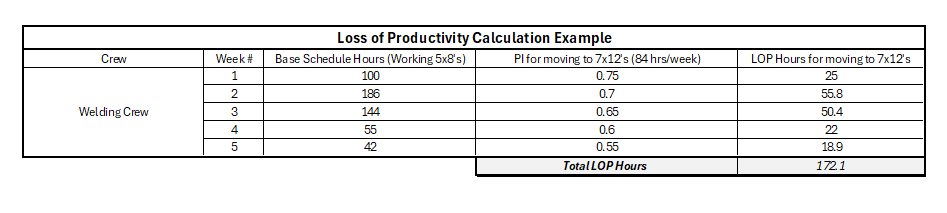
Example:
To meet schedule constraints, the owner requested working additional hours for the mechanical crews. The bid was prepared, assuming a 5×8’s work schedule, but the owner has requested working a 7×12’s schedule for 5 weeks. How many additional hours should the contractor charge for completing the work (in addition to OT costs) due to inefficiencies caused by overcrowding, poor coordination, or fatigue?