
Before the Bucket Hits the Ground: Planning Trench Work Around Live Utilities in Southern California
RyanCo Construction | Contractor resource
The ticket is clear, the paint is on the street, and the excavator is warmed up. Twenty minutes in, the bucket catches a line nobody expected at that depth. Now the crew is standing around, the utility’s repair truck is an hour out, the GC is on the phone, and the traffic control you’re paying for is protecting a hole nobody can work in.
A valid ticket doesn’t mean the strike risk is handled. The risk lives in the space between what the marks say, what the plans say and what’s actually in the ground. This article is about closing that gap: what California’s dig law requires, what Cal/OSHA requires once the trench gets deep, and the planning that keeps a crew from finding out the hard way.
It’s written for superintendents, foremen, estimators and PMs on water, sewer, storm drain and gas work. It summarizes the rules. It doesn’t replace them, and your contract, the agency’s specs and the utility owner’s requirements still govern.
The marks aren’t the whole picture
Three things about 811 marks catch people off guard.
First, marks don’t tell you depth. California’s dig law defines “locate and field mark” and says outright that it does not require an indication of depth. A paint line tells you where to look horizontally. It says nothing about whether the line is at 18 inches or 6 feet.
Second, some lines aren’t covered at all. The law’s definition of a “subsurface installation” excludes nonpressurized sewer lines, nonpressurized storm drains and other nonpressurized drain lines. A gravity sewer lateral or an old storm drain may not get marked, and the operator isn’t required to mark it under that article. Those are exactly the lines a sewer or storm drain contractor is most likely to be working next to.
Third, the marks only cover what the operators know about. Abandoned lines, private lines and anything a member doesn’t have in its records can still be in your trench.
That’s why the plans matter as much as the paint. Ryan Heather, who runs RyanCo, puts it this way from his own years in the industry:
“I’ve been on jobs where the utilities were even marked on the elevation profile, but the crew just went to work without reviewing the plans for that segment of pipe install and ended up hitting a line.”
The information was there. Nobody looked at it for that reach. The fix is simple and it costs a few minutes: before each segment, the foreman and operator walk the plan and profile for that run. Where does the new pipe cross existing lines? What depth does the profile show at each crossing? Which crossings need potholing before the machine gets close? Then compare that against the marks on the ground. When the plan, the profile and the paint disagree, stop and find out why before you dig.
811 and DigAlert: what Government Code 4216 requires
In Southern California the regional notification center is Underground Service Alert of Southern California, better known as DigAlert. The duties sit in Government Code sections 4216 through 4216.24. The ones that drive day-to-day planning:
- Delineate first. Mark the area you plan to excavate in white before you call (section 4216.2(a)). If you don’t, an operator may choose not to mark until you do.
- Call at least two working days ahead, and no more than 14 calendar days. The day you call doesn’t count (4216.2(b)). A working day is Monday through Friday, 7 a.m. to 5 p.m., excluding state and federal holidays (4216(v)). Call on a Thursday before a holiday weekend and the clock is longer than you think.
- Don’t dig until everyone has responded. Every operator on the ticket has to locate and mark, provide information, or report that it has nothing there, and must give an electronic positive response through the center before the legal start time (4216.3). You can’t start until all of them have done so and any required onsite meeting has happened (4216.2(g)).
- High priority lines need a meeting. If you’re within 10 feet of a high priority subsurface installation (for example, high-pressure gas over 60 psig, petroleum lines, pressurized sewage lines or high-voltage electric), the operator has to set up an onsite meeting, and you can’t excavate until that meeting is complete (4216.2(c)).
- Tickets expire. A ticket is valid for 28 days. Renew it by the end of the 28th day if work is continuing (4216.2(e)). If it lapses while you’re still working, stop, get a new ticket and wait for the responses again (4216.2(i)). On a long pipeline job, put renewal dates on the schedule.
- Faded marks mean re-marks. If the marks are no longer reasonably visible, request re-marks and stop work in that area. The operator has two working days to re-mark (4216.3(b)).
The tolerance zone and potholing
The tolerance zone is 24 inches on each side of the operator’s marking. If the operator marks the width of the line, the zone is measured from each outside mark, and if it marks a single line with the size specified, the zone grows by half that size on each side (4216(u)). Inside that zone, you have to find the exact location with hand tools before using any power-driven excavation or boring equipment (4216.4(a)(1)).
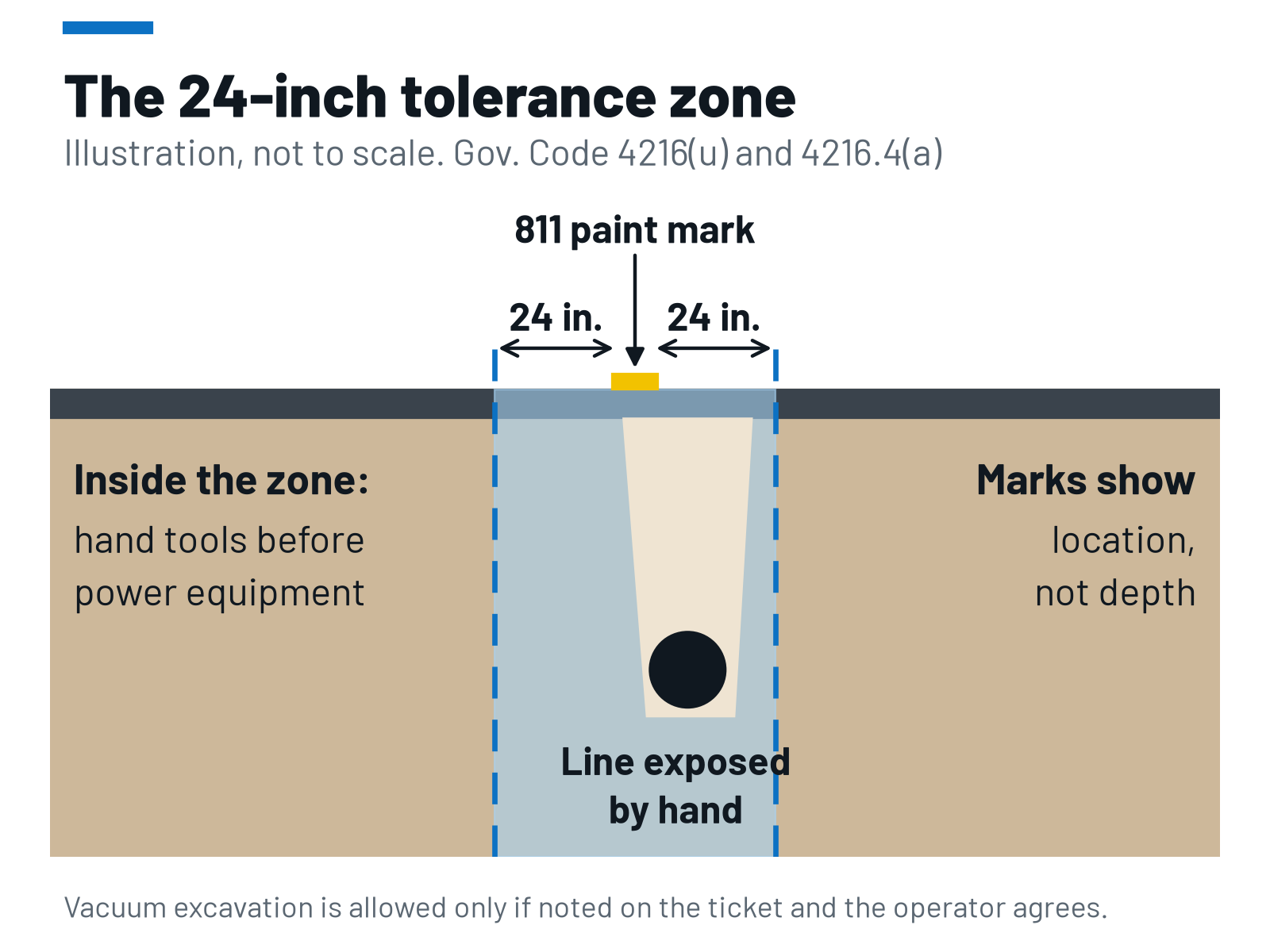
Illustration, not to scale. Click or tap to enlarge.
Vacuum excavation is allowed in the tolerance zone if you told the center you’d use it when you got the ticket and the operator agreed. An operator that doesn’t agree has to say so in its positive response (4216.4(a)(2)). And the law says to presume every line is active and treat possibly inactive lines with the same care (4216.4(a)(3)).
In practice, potholing every crossing shown on the profile before the trench gets there is cheap insurance. It turns “the plans say 4 feet” into “we saw it at 3 feet 2 inches,” and it gives the engineer time to adjust the grade before the pipe is in the ground instead of after.
When the locate is wrong
Sooner or later a line turns up where the marks or plans didn’t show it. What you do in the next hour matters for safety, and later for who pays.
- Stop and protect the area. If you damage a gas or hazardous liquid line and product is escaping, call 911 immediately, then the operator (4216.4(c)).
- Report any damage, not just breaks. Nicks, dents, gouges and damaged coating or cathodic protection all have to be reported to the operator immediately. You also have to notify the center within 48 hours of discovering or causing damage (4216.4(c)(2) and (3)). A scraped coating on a steel line that gets backfilled without a call is the kind of thing that turns into a much bigger problem years later.
- If you can’t find it by hand, ask. If hand excavation can’t pin down the exact location, request more information from the operator, which has one working day to provide what it has (4216.4(b)).
- Notify the owner in writing. On California public works, Government Code 4215 makes the public agency responsible for main or trunkline utilities that aren’t shown in the plans and specs with reasonable accuracy. The contract has to compensate the contractor for locating them, for repairing damage that wasn’t caused by a failure to use reasonable care, and for equipment necessarily idled, and the contractor can’t be charged liquidated damages for delay caused by the agency’s or utility’s failure to remove or relocate them. It also requires the contractor to notify the agency and the utility in writing immediately on discovery. Service laterals that can be inferred from visible facilities like meters and buildings are treated differently.
- Know the differing site conditions clause. For local agency contracts with trenches deeper than 4 feet, Public Contract Code 7104 requires a clause that has you notify the agency in writing, promptly and before the conditions are disturbed, when subsurface conditions differ from the information given to bidders.
- Write it down. Photos with a tape in the frame, depth and offset from the marks, time stopped, who was on standby and what equipment was idle. That record is what supports the time and cost request later.
None of this protects a crew that skipped the hand-dig in the tolerance zone. The rights in 4215 rest on “reasonable care,” and the first question anyone asks after a strike is whether the excavator followed 4216.4.
Cal/OSHA: permit, competent person and protective systems
Once a trench gets deep, a second set of rules applies.
- Excavation permit. Labor Code 6500 and Title 8, section 341 require a Cal/OSHA permit, either annual or project, for constructing trenches or excavations 5 feet or deeper into which any person is required to descend. “Descend” means entering any part of the trench once it has reached 5 feet. The permit has to be in hand before the work starts. The listed exceptions cover government bodies and PUC-regulated utilities themselves, plus emergency repair work. Contractors working for them aren’t on that list.
- Competent person. Title 8 defines a competent person as someone who can identify existing and predictable hazards and has authority to take prompt corrective action (section 1504). Under section 1541(k), that person inspects the excavation, the adjacent area and the protective system daily before work starts, as needed during the shift and after every rainstorm or other event that increases the hazard. If they find signs of a possible cave-in or a failing system, employees come out until it’s fixed.
- Protective systems. Every employee in an excavation must be protected from cave-ins unless the excavation is entirely in stable rock, or it’s less than 5 feet deep and a competent person finds no indication of a potential cave-in (1541.1(a)).
- Other details that get missed. Keep spoil and equipment at least 2 feet back from the edge, or use retaining devices (1541(j)(2)). Provide a ladder, ramp or stairway in trenches 4 feet or deeper so nobody travels more than 25 feet laterally to get out (1541(c)(2)). Protect, support or remove exposed utilities while the trench is open (1541(b)(4)). And train everyone involved in excavation on the 811 and dig-law practices (1541(b)(1)(D)).
Shoring in tight streets
Sloping looks cheap on paper. If you don’t classify the soil, Title 8 limits you to 1-1/2 horizontal to 1 vertical, the Type C slope (1541.1(b)(1)). For a 10-foot-deep trench, that’s 15 feet of horizontal run on each side, so the top of the cut is about 30 feet wider than the bottom. On most city streets in Southern California that’s the whole road, including the lane you were supposed to keep open. Sloping or benching for excavations deeper than 20 feet has to be designed by a registered professional engineer.
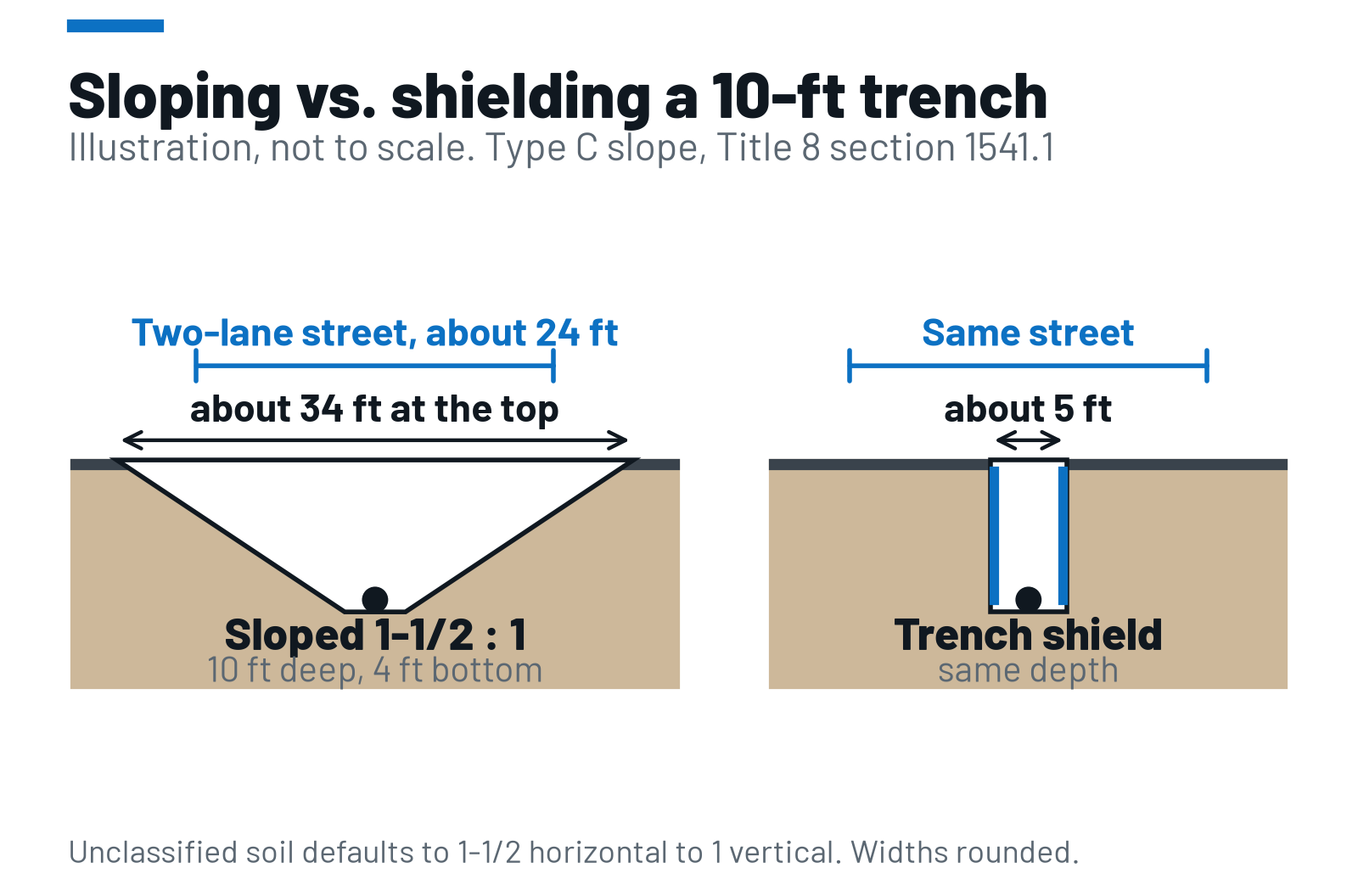
Illustration, not to scale. Click or tap to enlarge.
So in tight rights-of-way the real choices are trench shields, hydraulic shoring or engineered systems. A few things to settle before bid day:
- If you’re using manufacturer’s tabulated data, a written copy has to be on the jobsite while the system is in use, and you can’t deviate from it without the manufacturer’s written approval (1541.1(c)(2)).
- Where will spoil go? If there’s no room for it 2 feet back from the edge, it gets loaded and hauled, and that’s trucks, dump fees and import material for backfill.
- Adjacent structures. Sidewalks, curbs, walls and foundations can’t be undermined without a support system (1541(i)). An old block wall at the back of a sidewalk can change the shoring plan.
- Shield length versus pipe length. A shield too short for the pipe joints you’re laying slows every joint.
- Crossings. Shoring has to work around the existing lines you’ve potholed, which is one more reason to pothole early.
For more on how we approach this work, see our excavation, trenching and utility demolition services.
Shutdowns and temporary service
Cutting into a live water main or a sewer that can’t stop flowing is mostly a planning problem. The questions that drive cost and schedule are usually answered by the agency or utility, not by the contractor, so get them answered before you price the work:
- Who operates the valves? On most systems it’s the utility’s crew, on their schedule. If a valve doesn’t hold, the shutdown area grows.
- How long is the window, and when? Night or weekend windows change crew cost, lighting and inspection.
- Who notifies affected customers, and how far ahead?
- Who provides temporary service, and to what standard? For water, that can mean temporary lines with backflow protection and disinfection. For sewer, bypass pumping with backup capacity.
- What happens if the window closes before the tie-in is done? Know the fallback before you start.
- Are the fittings, couplings and restraints for the tie-in on site and checked against the actual pipe? A coupling that doesn’t fit an older pipe’s outside diameter can burn the entire window.
For more, see our wet utility construction and underground gas pipeline pages.
A pre-bid and pre-start checklist
Not every item applies to every job. These are the ones that tend to move the price or the schedule.
- Plan and profile reviewed segment by segment for every existing crossing, with depths noted.
- Which crossings show “approximate” or “per records” locations, and who is responsible for potholing them.
- Gravity sewer, storm drain and private lines that won’t be marked through 811.
- High priority lines within 10 feet of the work, and lead time for the operator meeting.
- Trench depths over 5 feet, the permit in place, and the protective system planned for each depth and width.
- Room for spoil, shoring and traffic control within the permitted work area and hours.
- Shutdown windows, valve operation, customer notice and temporary service responsibility, all in writing.
- Ticket renewal dates on the schedule for long runs.
- How the contract handles unknown utilities and differing site conditions, and the notice deadlines.
Questions worth asking the owner and engineer
- What’s the source of the utility information on the plans, and when was it last updated?
- Has any potholing already been done, and can we see the results?
- Are there known abandoned lines in the alignment?
- Who is responsible for temporary service during each shutdown?
- If we find a conflict at a crossing, how fast can the engineer turn around a grade or alignment change?
If you’re bidding public utility work in Orange County, our Orange County public works bidding guide covers where those projects get posted.
The short version
811 tells you roughly where the known, pressurized lines are. It doesn’t tell you depth, and it may not tell you about the gravity lines at all. Read the plan and profile for every segment before you dig it, pothole the crossings, keep the ticket current, and put a competent person on every trench. If something doesn’t match, stop and write it down. The few minutes that takes are a lot cheaper than a strike.