
Orange County Public Works Bidding Guide: Agencies, Portals, and How the Process Works
Who issues the work, where bids are posted, how a typical bid moves from advertisement to award, and the basics of bonds and CUPCCAA.
RyanCo Construction | Contractor resource
If you build public works in Orange County, the first thing to understand is that there is no single place to find the work. The County, each city, the water and sanitation districts and a long list of other agencies all advertise and award their own contracts, on their own schedules, through their own systems. Contractors who bid this market steadily treat finding the bids as part of the job, not an afterthought.
This guide covers who issues the work, where it gets posted, how a typical bid moves to award, and what bonding and CUPCCAA mean for those contracts. It is written from the contractor side.
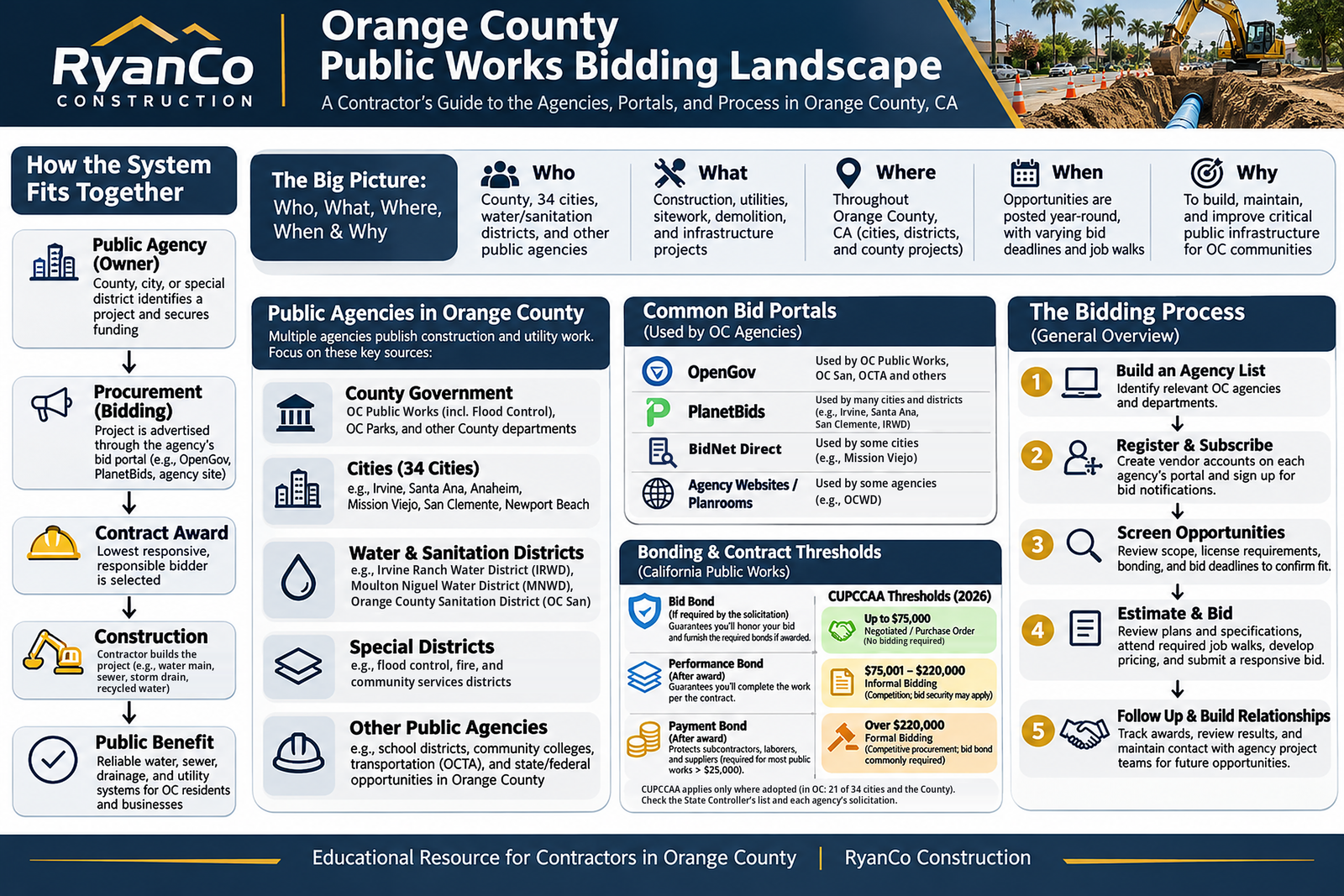
Click or tap the graphic to open the full resolution version in a new tab.
About this resource: This is an educational resource prepared by RyanCo Construction. It is not an official Orange County publication. Requirements change and vary by agency, so verify the details in each solicitation and with the issuing agency before you bid.
In this guide
The Orange County Public Works Landscape
Public works in Orange County is spread across many separate owners, each with its own purchasing rules, vendor list and bid calendar.
County of Orange and Its Departments
The County of Orange procures construction for its departments, such as OC Public Works and OC Parks. OC Public Works also runs projects for the Orange County Flood Control District, which is a separate special district governed by the Board of Supervisors. County solicitations run through the County Procurement Office, which lists active County bid solicitations and explains how to sign up on its vendor registration page. The Clerk of the Board keeps a construction bid openings calendar for County construction projects, and OC Public Works is the department behind much of the County's road, flood control and infrastructure work.
The 34 Cities
Orange County has 34 incorporated cities, from Aliso Viejo to Yorba Linda, according to the County's own list of Orange County cities and the Orange County Local Agency Formation Commission. Each city runs its own public works program and its own bidding. Larger cities such as Anaheim, Irvine and Santa Ana put out a steady flow of street, sewer, storm drain and water work. Smaller cities bid projects too, and those are easy to miss if you only watch the big names.
Water and Sanitation Districts
Water and wastewater agencies are some of the most active owners of underground work in the county: pipeline replacements, sewer rehabilitation, pump station work and service connections. Examples include the Orange County Sanitation District (OC San), Irvine Ranch Water District (IRWD), Moulton Niguel Water District (MNWD) and the Orange County Water District (OCWD). Some districts prequalify contractors before they can bid larger construction projects, so read each district's contractor requirements early, not the week a bid is due.
Special Districts and Other Public Agencies
Beyond the County, the cities and the water districts, there are special districts such as fire, recreation and community services districts. There are also school districts, community college districts and regional agencies like the Orange County Transportation Authority, which posts its solicitations through OCTA procurement.
The takeaway is simple: each of these owners procures on its own. There is no single central system that covers them all.
Where to Find Orange County Bids
The Issuing Agency vs. the Hosting Platform
It helps to separate two things: the agency that issues the bid and the platform that hosts it. The agency owns the project, writes the specifications, answers questions and awards the contract. The platform is the software where the notice, plans, addenda and sometimes the bid submission itself live.
The two platforms you will see most in Orange County are PlanetBids and OpenGov. You may also see BidsOnline, but that is not a separate platform. It is PlanetBids' own product name, so a city page that says its bidding system is "powered by BidsOnline" is a PlanetBids portal. A few cities use BidNet Direct, where agencies post bids through the California Purchasing Group, BidNet's statewide group of participating California agencies. Some agencies still post notices, plans and planroom links on their own websites.
Examples of Who Uses What
Here is where several Orange County agencies posted bids when we checked in November 2026:
| Agency | Where bids are posted |
|---|---|
| County of Orange (including OC Public Works and OC Parks) | OpenGov |
| OC San (Orange County Sanitation District) | OpenGov, for public works since January 1, 2026 |
| OCTA | OpenGov, which replaced CAMM NET for solicitations |
| City of Anaheim | OpenGov since December 2, 2024 (older bids on PlanetBids) |
| City of Irvine | PlanetBids, branded as BidsOnline |
| City of Santa Ana | PlanetBids |
| City of Mission Viejo | BidNet Direct (California Purchasing Group), plus ciplist.com for construction projects |
| Irvine Ranch Water District (IRWD) | PlanetBids, with contractor prequalification required for many projects |
| Moulton Niguel Water District (MNWD) | PlanetBids |
| Orange County Water District (OCWD) | Its own website plus the OCWD online planroom |
Agencies change providers from time to time, so treat this as a snapshot. The agency's own purchasing or engineering page is the best place to start, and it will usually link to wherever its bids currently live.
One Registration Does Not Cover Every Agency
Registering with one agency, or on one platform, does not register you with the others. Even when two agencies use the same software, each one usually keeps its own vendor list, its own commodity code selections and its own notification settings. If you want to see bids from ten agencies, plan on setting up and maintaining ten registrations.
Agency registration is also separate from state requirements. In California, a contractor or subcontractor has to be registered with the Department of Industrial Relations to bid on or be listed on a public works project (Labor Code Sections 1725.5 and 1771.1). The DIR public works contractor registration page explains who must register.
How the Public Works Bidding Process Works
Forms and deadlines differ, but most Orange County agencies follow a similar sequence.
1. Identify the Agencies
Start with the owners that actually build your type of work. For underground utility work, that usually means water districts, sanitation agencies and city public works departments first.
2. Register as a Vendor
Create a vendor account with each agency, on whatever system it uses, and complete the profile fully. Incomplete profiles and wrong contact emails are a common reason contractors never see a bid notice.
3. Monitor for Opportunities
Notifications are only as good as the codes behind them. Check the portals and agency pages you care about on a regular schedule.
4. Review the Bid Documents
Read the notice inviting bids, the instructions to bidders, the bid schedule, the special provisions and the plans. Look for license requirements, prequalification, bonding, insurance, schedule limits and any local hiring or reporting requirements before you spend time on a takeoff.
5. Attend Mandatory Pre-Bid Meetings and Job Walks
If a pre-bid meeting or job walk is marked mandatory, treat it that way. Missing it can make your bid nonresponsive. Sign in, note site conditions and write down questions to submit in writing.
6. Estimate the Work
Build the estimate from the plans, the specifications and what you saw in the field, including utility conflicts, traffic control, dewatering, shoring, testing and restoration. Send questions before the question deadline closes.
7. Submit a Responsive Bid
Follow the submission instructions exactly. Acknowledge every addendum, use the agency's bid forms, list subcontractors as required and include the bid security. Leave time for upload problems on electronic portals.
8. Follow Up on Results
Check the bid results and keep the tabulation. Even when you are not low, it shows who bids that agency and at what level.
Bonding and CUPCCAA
Bid, Performance and Payment Bonds
Most public works contracts involve three kinds of surety protection.
Bid security (bid bond)
Submitted with the bid. For cities, it can be cash, a cashier's check, a certified check or a bidder's bond from an admitted surety, of at least 10 percent of the bid, and it is forfeited if the successful bidder fails to sign the contract (Public Contract Code Sections 20170 through 20172). Counties accept the same four forms (Section 20129(a)). Districts set bid security in their own enabling acts or contract documents; 10 percent is common.
Performance bond
Provided after award. It guarantees the work is completed according to the contract. It is required by statute on county construction contracts (Public Contract Code Section 20129(b)); for other agencies it comes from their own statutes and contract documents.
Payment bond
Required of the direct contractor on a public works contract over $25,000, before work begins (Civil Code Section 9550). It must be at least 100 percent of the contract amount and written by an admitted surety (Civil Code Section 9554), and it protects subcontractors, laborers and suppliers. Contracts with state entities fall under a separate statute.
The solicitation will state what security is required and in what form, so verify the bond requirements in every bid package. If you are newer to public work, talk with your surety before you bid, not after you are low.
How CUPCCAA Affects Some Contracts
The Uniform Public Construction Cost Accounting Act, usually called CUPCCAA, is found in California Public Contract Code Section 22000 and following. It is optional. A local agency opts in by resolution, and the program is overseen by the California Uniform Construction Cost Accounting Commission with support from the State Controller's Office.
Agencies that opt in can use alternative bidding procedures based on project cost. The limits in Public Contract Code Section 22032 have been in effect since January 1, 2025 under AB 2192, and no change was found for January 1, 2027:
$75,000 or less
The agency can use its own forces, a negotiated contract or a purchase order. No bidding is required.
$220,000 or less
The agency can use informal bidding. The notice goes to the contractors on the agency's qualified contractor list for that category of work at least 10 calendar days before bids are due, or to construction trade journals (Section 22034). It does not have to be a public advertisement.
Over $220,000
Formal bidding, with a newspaper notice at least 14 calendar days before bid opening and notice to trade journals at least 15 days before (Section 22037).
If every bid comes in over $220,000, the governing board can still award up to $235,000 by a four-fifths vote if it finds the agency's estimate was reasonable (Section 22034). Award goes to the lowest responsible bidder, and agencies cannot split a project to stay under the limits. CUPCCAA changes the bidding procedure only. Bond, prevailing wage and insurance requirements still apply.
The practical point for a contractor: informal CUPCCAA bids go to the agency's list, so if you want that work, contact each participating agency directly and ask how to get on its contractor list.
Which Agencies Use CUPCCAA
Only agencies that have opted in use these procedures. According to the State Controller's participating agencies list (updated October 14, 2026), Orange County participants include the County of Orange and 21 of the 34 cities. Many Orange County school and community college districts have also adopted CUPCCAA, so if you bid school or college work, check the list for each district. Several large owners are not on the list, including IRWD, MNWD, OCWD, OCTA and the cities of Anaheim, Santa Ana, Huntington Beach and Newport Beach. Those agencies follow their own statutes or charters. For example, general law cities that have not opted in must formally bid public projects over $5,000 (Public Contract Code Section 20162). Participation can change, so check the current list and each solicitation.
Practical Takeaways
- Keep an agency registration list.Track every agency and platform you are registered with, the login email, any annual contractor list you need to renew, and when you last updated the profile.
- Choose the right commodity codes.Pick codes that match the work you actually perform, such as water main, sewer, storm drain, recycled water or excavation, and review them once a year. Too narrow and you miss bids; too broad and the real ones get buried.
- Track mandatory job walks and deadlines.Put every mandatory meeting, question deadline and bid due date on a shared calendar the day you download the documents.
- Watch addenda.Follow or subscribe to each project you plan to bid, check for addenda right up to bid time, and acknowledge every one on the bid form.
- Learn which agencies regularly bid your type of work.Review past bid results and planholder lists, then focus your registrations and estimating time on the owners that put out the work you build best.
Working With RyanCo on Underground Utility Bids
RyanCo Construction is an underground utility contractor based in Laguna Hills, working on wet utility, excavation and trenching and gas pipeline scopes. You can see everything we do on our services page.
Our approach is straightforward: Competitive Pricing. Clear Scopes. Fewer Surprises.
If you have underground utility work coming up for bid in Orange County, we would be glad to review the plans and specifications. Contact RyanCo Construction to send over a bid opportunity.